
 Facebook
 X
X
 Pinterest
 Copy Link
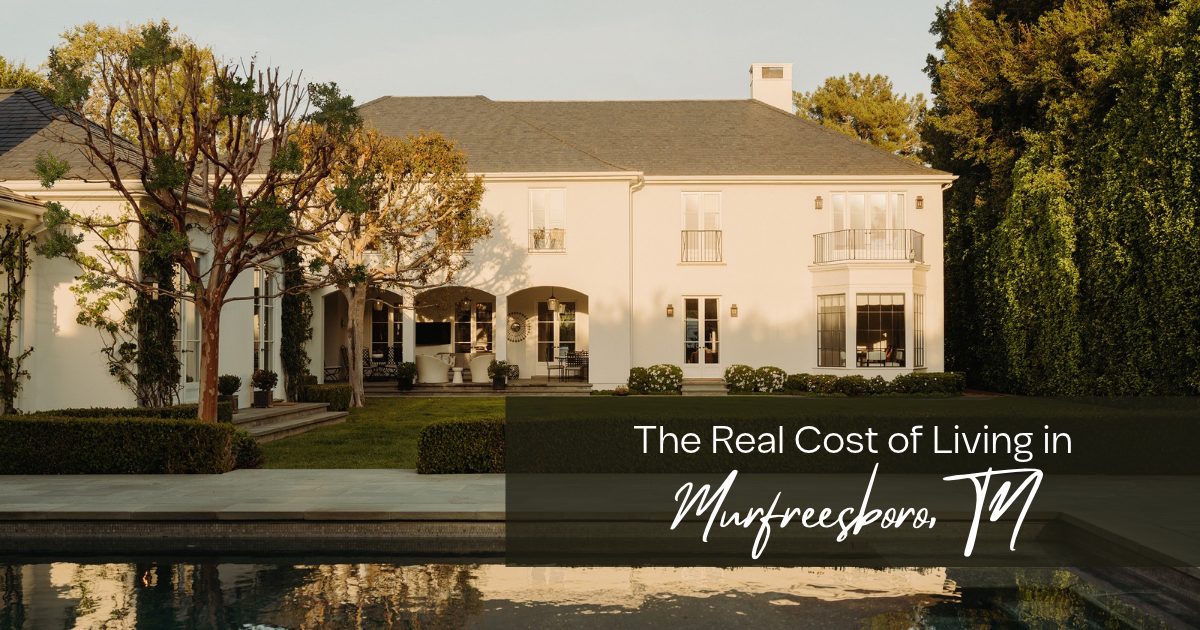
When planning a move to Middle Tennessee, people are drawn by our thriving economy, scenic landscapes, and welcoming communities. But before making any major real estate decision, smart buyers look past the listing photos and ask practical financial questions: What does it actually cost to live here day to day?
Compared to national averages—and especially compared to higher-tax states in the Northeast, Midwest, and West Coast—Murfreesboro provides notable financial relief. However, understanding the exact mechanics of local taxes, dual municipal boundaries, and regional utility providers is critical to avoiding surprises on your monthly ledger.
Grab a cup of coffee, and let’s break down the realistic cost of living in Murfreesboro.
1. The Tennessee Tax Advantage: No Personal Income Tax
The cornerstone of Tennessee’s financial appeal is that there is zero state personal income tax on earned wages.
Whether you are an employee, business owner, or remote worker, you keep more of your paycheck right out of the gate. Retirees also benefit significantly because Tennessee does not tax pension income, 401(k) withdrawals, or Social Security benefits.
The trade-off: Tennessee relies more heavily on state and local sales tax to fund public services and infrastructure. Total sales tax in Rutherford County sits at 9.75% (combining the state base rate with county additions).
2. Understanding Murfreesboro & Rutherford County Property Taxes
Property taxes in Tennessee are straightforward once you understand the formula, but living inside versus outside city limits makes a difference.
The 25% Residential Assessment Ratio
In Tennessee, residential property is not taxed on 100% of its market value. Instead, state law dictates an assessment ratio of 25%.
-
For example, if a home is appraised by the Rutherford County Property Assessor at $400,000, its assessed taxable value is only 25% of that amount ($100,000). The local tax rate is then applied per $100 of that assessed value.
City Limits vs. County Unincorporated Areas
-
Inside Murfreesboro City Limits: Homeowners pay both the Rutherford County property tax (collected by the County Trustee) and the City of Murfreesboro municipal tax. In exchange for the municipal tax, city residents receive city trash pickup, city police and fire services, and access to Murfreesboro City Schools for primary grades.
-
Outside City Limits: Properties situated in unincorporated county areas pay only the Rutherford County property tax rate. However, these homes typically arrange private trash collection and rely on county sheriff and volunteer/county fire districts.
3. Utility Providers & Monthly Operating Costs
Setting up your household services involves working with specific local providers depending on your address:
-
Electricity: Provided by Middle Tennessee Electric (MTE). MTE operates as a member-owned electric cooperative (one of the largest in the nation), which historically delivers reliable power and competitive rates compared to national commercial utilities.
-
Water & Wastewater: Inside the city, public water, sewer, and stormwater services are managed by the Murfreesboro Water Resources Department (MWRD). In suburban and unincorporated county pockets, drinking water is supplied by the Consolidated Utility District (CUD), with wastewater often handled via private septic systems or decentralized community plants.
-
Natural Gas: Residential natural gas service across most of Murfreesboro is provided by Atmos Energy.
-
High-Speed Internet: Coverage is robust, with high-speed fiber and broadband widely available from providers including AT&T Fiber, Comcast Xfinity, and expanding regional fiber networks.
4. Everyday Budget Realities: Groceries, Healthcare, and Transportation
Beyond the mortgage and utilities, day-to-day essentials in Murfreesboro remain competitive:
-
Healthcare: Anchored by Ascension Saint Thomas Rutherford Hospital and extensive outpatient surgical clinics along Medical Center Parkway, residents enjoy access to comprehensive medical care without the long drive into downtown Nashville.
-
Groceries & Dining: Murfreesboro offers grocery options for every budget—from regional favorites like Publix and Kroger to discount staples like ALDI, alongside local farmers markets on the Downtown Square.
-
Transportation & Gas: While Tennessee fuel taxes remain moderate, daily commute expenses depend on whether you work locally in Rutherford County or commute northwest on I-24 toward Nashville.
Balancing Affordability with Lifestyle
Living in Murfreesboro offers a rare balance: the financial benefits of a low-tax state combined with modern suburban infrastructure, excellent parks, and established neighborhoods. Partnering with a knowledgeable local advisor ensures you understand how property boundaries, tax rates, and utility setups impact your overall budget before making an offer.
4. Frequently Asked Questions (FAQs)
Q1: Does Tennessee have a state income tax? A: No, Tennessee has no state personal income tax on earned wages, salaries, or retirement income.
Q2: How are residential property taxes calculated in Rutherford County, TN? A: Residential property is assessed at 25% of its appraised market value. That assessed figure is then divided by 100 and multiplied by the certified local tax rate.
Q3: Do homes in Murfreesboro pay two property tax bills? A: Yes, homes located inside Murfreesboro city limits receive an annual county tax bill from the Rutherford County Trustee and a separate municipal property tax bill from the City of Murfreesboro.
Q4: Who provides electric service in Murfreesboro? A: Electricity is provided by Middle Tennessee Electric (MTE), a member-owned non-profit electric cooperative.
Q5: What is the difference between MWRD and CUD for water? A: Murfreesboro Water Resources Department (MWRD) provides city water and municipal sewer inside city limits, while Consolidated Utility District (CUD) supplies water service across unincorporated areas of Rutherford County.
Q6: What is the total sales tax rate in Murfreesboro, TN? A: The combined sales tax rate in Rutherford County is 9.75%, consisting of the state base rate (7.0%) plus the local county option (2.75%).
Q7: Is natural gas widely available in Murfreesboro neighborhoods? A: Yes, natural gas service is available across most established and modern Murfreesboro subdivisions through Atmos Energy.
Q8: Are property taxes cheaper outside Murfreesboro city limits? A: Yes, properties located outside municipal boundaries pay only the Rutherford County tax rate, avoiding the additional city municipal tax levy.
Q9: Does Tennessee offer property tax relief for seniors? A: Yes, the State of Tennessee and Rutherford County offer property tax relief and tax freeze programs for qualifying low-income senior citizens (age 65+) and disabled homeowners.
Q10: Are HOA dues included in property tax bills? A: No, HOA fees are private neighborhood dues paid directly to your community’s management association and are completely separate from county or city property taxes.
Trying to evaluate property tax rates across different neighborhoods, or wondering how your monthly budget compares in Murfreesboro? Let’s grab a cup of coffee and break down the numbers together.
Daniel Curtis | Coldwell Banker Southern Realty
Hyperlocal Knowledge. Real Heart.
📱 Contact me directly to start the conversation today!
